
Settings Reference
⌘, / Ctrl+, opens Settings. The categories are listed where the threads sidebar usually is, and there is a search box — every control on this page is findable by name or by synonym, so "dark mode" finds Theme and "spacemouse" finds 3D mouse. The same pages and controls are searchable from the command palette without opening Settings first — they appear there as Settings: … rows.
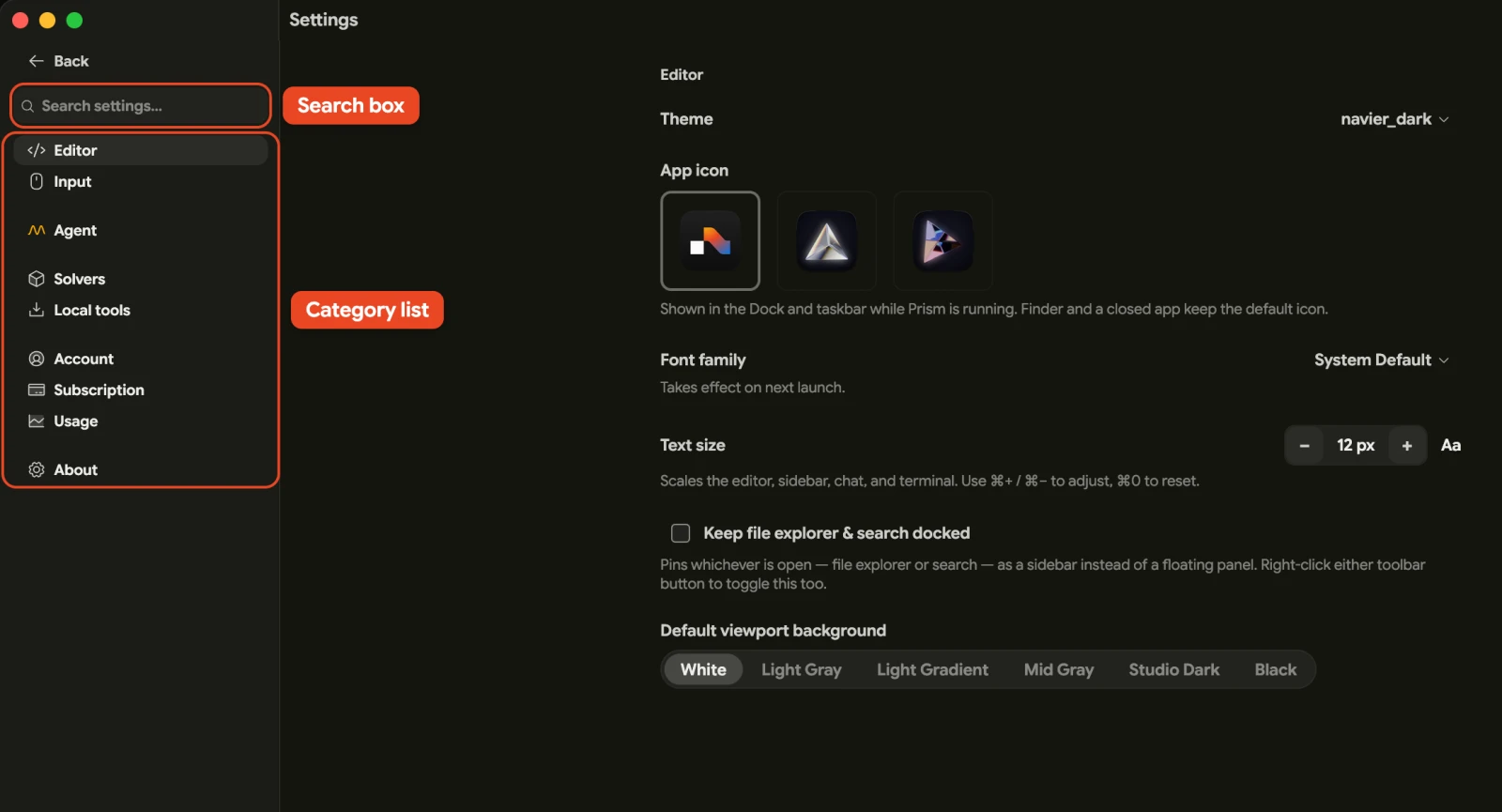
The category list is grouped under four labels: Preferences (General, Agent), Compute (Solvers, Local tools), Account (Account, Subscription, Usage) and Qubis (About). Each category is one page of titled sections, and a search result or a Settings: … row in the palette opens the page scrolled to the section it matched.
General
Four sections — Appearance, Layout, 3D viewport and Storage.
| Setting | What it does |
|---|---|
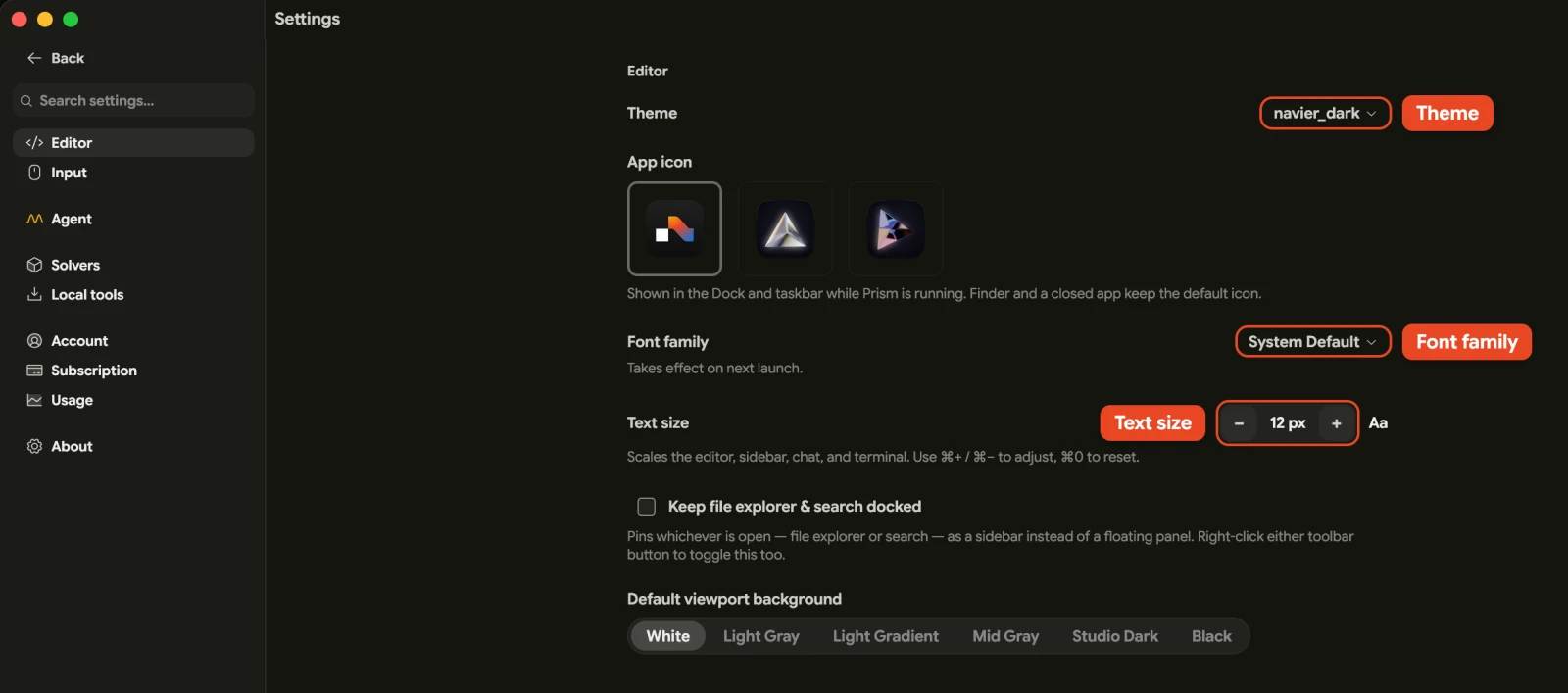
| Theme | Editor and UI theme. Nine ship in the box, from Qubis Dark to Rosé Pine. Also switchable from the command palette. |
| App icon | The icon Qubis shows in the Dock or taskbar while it runs — the Qubis mark by default, or one of two crystal tetrahedra. The installed app icon is unchanged. |
| Font family | The editor typeface. System Default uses your platform's default monospace font. |
| Text size | Editor text size. ⌘+, ⌘−, and ⌘0 also change it. |
| Keep file explorer & search docked | Off by default — the explorer and search open as a floating panel. On, they hold a column of their own in the right pane on the chat, and their shortcuts bring that pane up to show it. |
| Default viewport background | Which of the six backgrounds the 3D viewports use. Same setting as the viewport's own Background picker. See 3D Viewport. |
The 3D mouse setting (a 3Dconnexion SpaceMouse driving the viewport camera) is in General → 3D viewport, next to the default background. On by default; needs the 3DxWare driver installed. Clear generated previews is in General → Storage.
Agent
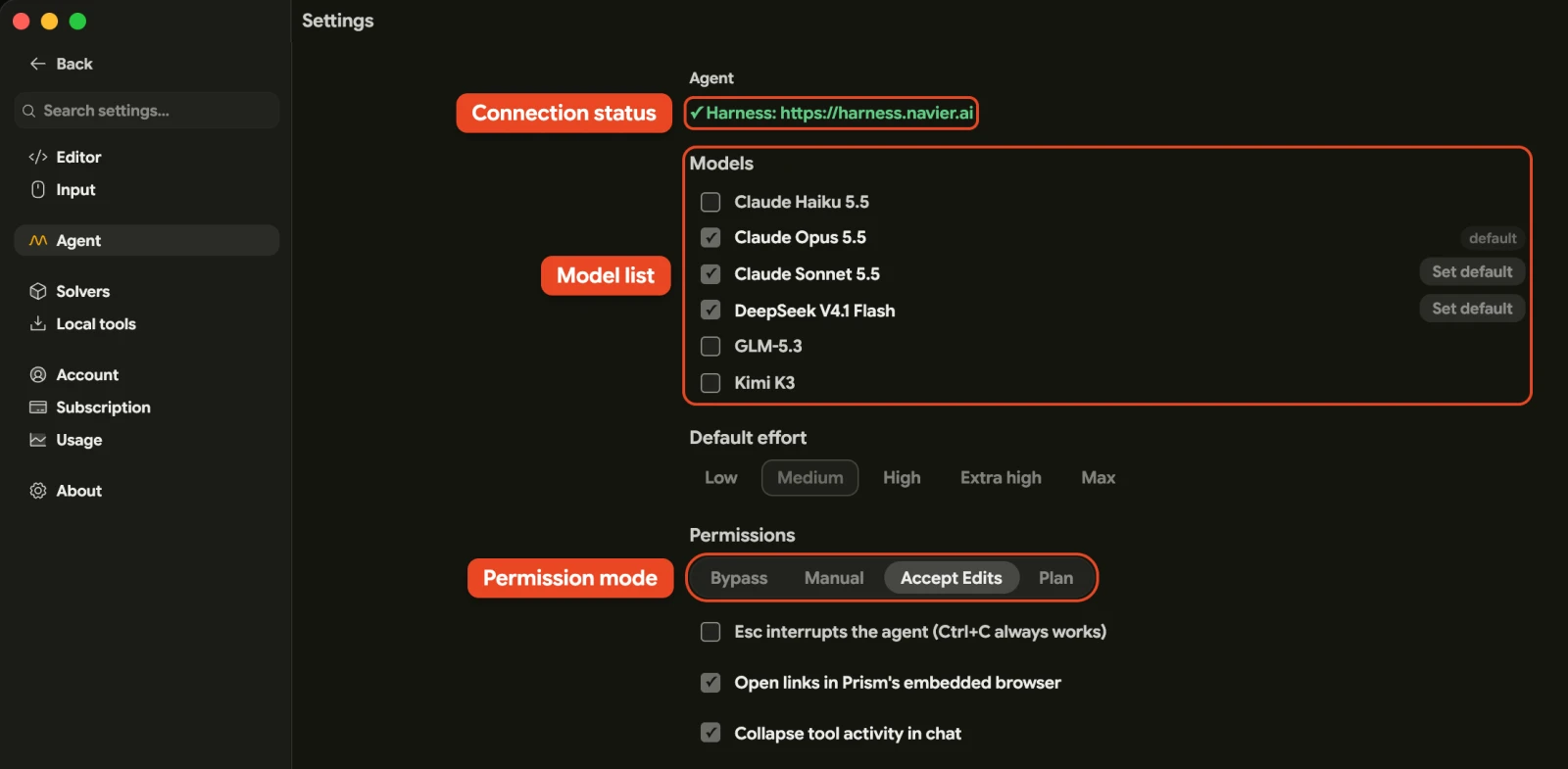
Everything about how the agent behaves, in four sections — Models, Permissions, Chat and Custom instructions. The agent's connection status heads Models rather than holding a section of its own.
Models
| Setting | What it does |
|---|---|
| Models | Which models appear in the composer's picker, and which is the default. Enable the ones you use; leave the list empty to show all available models. |
| Default effort | The reasoning-effort level a new turn starts on. Effort ladders differ per model, so this resolves against whichever model is active. |
Permissions
| Setting | What it does |
|---|---|
| Permission mode | Bypass, Manual, Accept Edits, or Plan. New installs start on Accept Edits. ⇧Tab cycles it from the composer. |
| Shell always-allow rules | The shell allowlist. Rules match on an argv prefix and never match a command containing shell metacharacters. |
| Let my other computers change the permission mode of chats running here | Off by default. On, a chat this computer hosts can have its mode changed from your other computers. |
Chat
| Setting | What it does |
|---|---|
| Esc interrupts the agent | Off by default. On, Esc stops a streaming response, a pending question included. ⌃C always does, either way. |
| Collapse tool activity in chat | On by default. A run of uninterrupted tool calls collapses behind one expandable row. Off renders every row inline. |
| Thinking icon | The glyph style used for the agent's thinking rows. |
| Open links in Qubis's embedded browser | On by default. Off sends the agent's links to your system browser instead. |
Custom instructions
A box of your own text, added to every conversation's system prompt — house conventions, units, the solvers you actually use, how you want results reported. It applies to every thread on this computer, so instructions that belong to one project belong in the project instead.
Solvers
How navier-solverd runs, in four sections — Runtimes, Cloud runs,
Execution and Advanced. See
Solver Desk.
| Section | Setting | What it does |
|---|---|---|
| Runtimes | Solver runtimes | Which runtimes are installed, and what the daemon supports |
| Cloud runs | Enable cloud runs | Lets the daemon run cases on Qubis compute. Qubis creates an API key for this machine, limited to your active organization, and keeps it in your system keychain |
| Execution | Core budget override | Cores the daemon commits to solvers, replacing its auto-detected default |
| Execution | Idle shutdown override | Minutes with no runs and no requests before the daemon exits |
| Advanced | Custom runtime catalog | Path to a JSON file of extra or override runtime descriptors |
| Advanced | Port override | The port the daemon binds, replacing its default |
Advanced is folded away behind Show daemon settings, because the two fields under it are for a daemon you are deliberately running differently.
All four overrides take effect on the daemon's next start. It reads them once at startup and does not hot-reload.
This page also lists the built-in capabilities — the physics that ships with Qubis, currently Ferro — with the versions of the crates behind them.
Local tools
One section, Installed programs — the programs Qubis relies on but does not bundle: a container engine, Gmsh, an Office suite (LibreOffice, or Word and PowerPoint on Windows), Typst, Node.js, and the Pyright, TypeScript and rust-analyzer language servers. One card each, with what Qubis needs it for and whether it is installed. The Container engine card carries a picker for which engine — Colima or Docker Desktop on macOS, Podman or Docker Desktop on Windows, Podman or Docker Engine on Linux.
Opening the category re-runs detection, and the settings search finds the category by tool name.
| Control | What it does |
|---|---|
| Tick box per tool | Which missing tools the next install covers |
| Install selected (n) | Installs the ticked ones, reporting progress on their rows |
| Cancel installs | While an install is running, stops the whole run |
| Check again | Re-detects, for a tool you installed yourself |
Installs run per tool, so one working does not stop you starting another.
The agent also offers each of these with an Install card in the chat when a task needs one; this page is for installing ahead of time. On Linux, the ones that need root are shown as commands to copy and run rather than installed for you. See Environment Setup.
Account
| Setting | What it does |
|---|---|
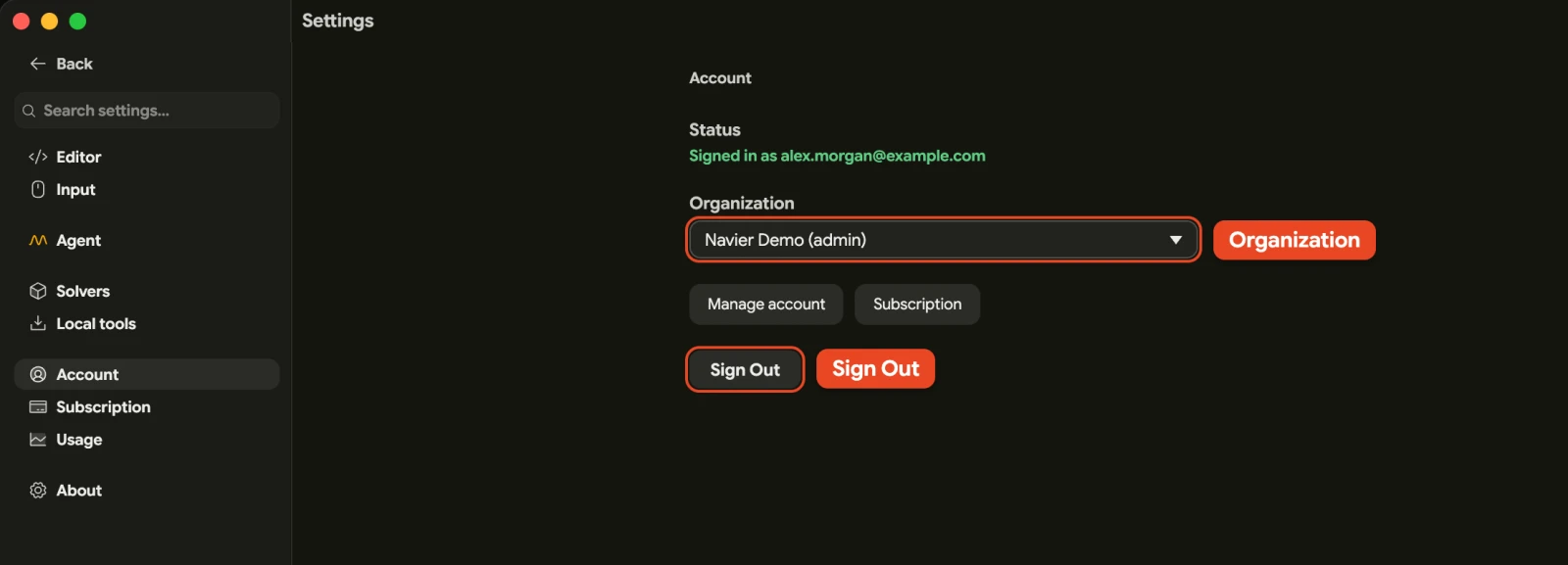
| Sign out | Ends the session and returns the window to the sign-in gate. |
| Organization | Which organization you are working under, if your account belongs to more than one. Persisted and restored on the next sign-in while you are still a member. |
Subscription
What the organization is on, and what it has left to spend: the plan and its status, the LLM credits the plan includes, seats, and past invoices — the purchased balance and the one place that sells more are on Usage. Under the plan name is the window it bills over — Billing period, with its start and end dates, so an annual subscription spans the year; a free plan reads Allowance instead, and one Qubis invoices directly reads Started, with no end date.
The Plan card carries the balance under the plan's name — 10.00 in free AI credits left, or …in AI credits left this period on a paid plan, in amber once it is spent. An admin on a plan that cannot buy credits gets the step that changes it in the card's heading: Subscribe where subscribing is open, Manage subscription on a self-serve plan, and Contact Qubis on one Qubis invoices or that is suspended. On a Free plan the card also says outright that Free plans can't buy more credits. Subscribe for a monthly credit allowance. A member who does not administer the billing gets Only organization admins can upgrade or buy credits. at the foot of the card, and sees none of the credit or seat controls.
A Free organization is not shown cards that would only be empty: the seats card is gone while you are its only member with no invitations out, and the invoices card while nothing has been billed.
A purchase in flight shows a spinner until it settles. One left unfinished — a closed checkout window, a dropped connection — offers Retry purchase, or close the dialog and Refresh to check where it got to before starting another one. Refresh is only there while a checkout is unconfirmed or the page failed to load; an unfinished checkout is also re-checked on its own when the page opens and when the window comes back to the front.
A member carried over on the old view-only role reads View (legacy) and keeps that role until an admin changes it.
Choosing a plan
Subscribe, in the Plan card's heading, opens Choose a plan for a Qubis subscription. Qubis is sold both monthly and annually, so the dialog offers a Monthly and an Annual card and highlights the one you pick; where the annual price works out cheaper than twelve monthly ones, Annual carries a Save N% label saying by how much. Annual is paid up front, and its credits still refill every month rather than arriving as a year's worth at once. Only the intervals actually priced for your organization appear — if just one is, that is the only card you get.
The dialog states what one seat includes — its AI credits, and the cloud core-hours as well on a plan that has them — so the price is next to what it buys.
Set the seats and the row beside them totals what that costs per period. A promo code goes in on the payment page, not here. The last step is the auto-renewal checkbox, which states the total you are agreeing to renew at; changing the plan or the seat count unticks it, so what you consented to always matches what is on screen. Subscribe opens checkout in your browser — finish it there, then Refresh. Pressing it with the box unticked says so rather than doing nothing: Confirm automatic renewal to continue.
Per-member limits
Each member's row in the team card carries what they have spent — 500.00 / month against a limit, or $12.40 this month · no limit without one — and a pencil, Edit monthly limit and role, which opens Manage member.
That dialog sets the member's Monthly limit (USD) and role. Tick No limit to lift it, which is where a new seat starts. The limit resets monthly with the organization's credits, and members spend from the same pool — so without one, a single member can spend all of it.
Usage
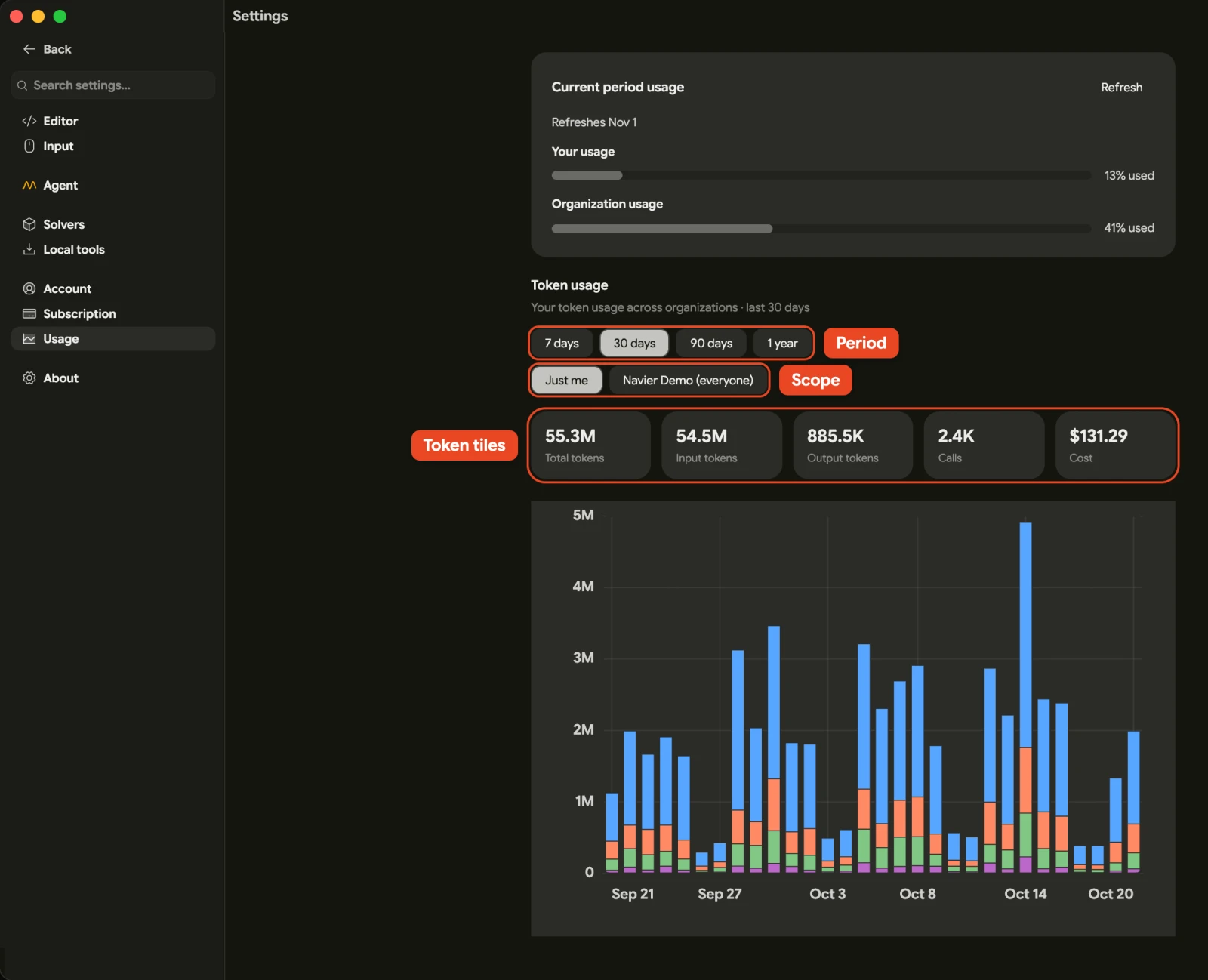
Current period usage opens the page: Your usage against whichever is lower of your own monthly limit and the organization's remaining credits, and Organization usage under it — or just the words Unlimited credits on a plan that has them. When the next refill happens at a fixed time the card reads Refreshes Nov 12 at 2:03 PM; when it waits on the renewal payment going through, it reads Refreshes Nov 12, to the day. A plan whose credits do not refresh shows no such line.
Under that, for an organization admin, the Purchased Usage Credits card: the balance bought on top of the plan, and Buy credits — the one place in Qubis that sells them. Purchased credits are spent after the plan's included credits and do not expire. A plan that cannot buy them shows the card without the button.
Below it, Token usage: tiles for total tokens, input and output tokens and the call count, over a window you choose. One row of dropdowns above them sets what the rest of the section shows; none of the three is labelled — each reads its own current value.
| Dropdown | What it does |
|---|---|
| The window | 24 hours, 7 days, 30 days, 90 days, 1 year, or Custom range… |
| The scope | Just me, or the organization's name followed by (everyone) — only on an admin seat |
| The metric | Tokens, Cost or Agent calls — the chart and the table only, since the tiles always count tokens and calls |
Custom range… swaps the preset list for a month calendar inside the same dropdown: pick a start date, then an end date — the foot of the panel reads pick a start date, then from Oct 25, then the range itself — and Apply sets it. Back returns to the presets. The range is inclusive and runs midnight to midnight in your own timezone, daylight-saving changes included, and cannot span more than a year. Once it is applied, both the dropdown and the subtitle read the dates rather than "last …".
Moving the metric between Tokens, Cost and Agent calls redraws the chart and the table on the spot, out of numbers the page already holds. Changing the window or the scope has to ask the server: the last numbers stay on screen, faded, beside Refreshing…. Large counts are abbreviated — 12.4K on a tile, 450M on an axis — and Cost gives the chart a currency axis.
The chart stacks each day by model, so the split between models is read from the bars rather than inferred from a total — hover a day for that day's per-model breakdown. Below it, Usage by model is one table — Model, Provider, the selected metric, and Share, over a Total row — sorted by that metric, largest first, each row keeping the colour it wears in the stack. A share with no total to divide by reads —.
A window nothing was spent in reads No usage in this period., and a request the server turns down is reported in place of the tiles.
Useful for calibrating effort settings — a high-effort session on a large codebase costs materially more than a low-effort one, and this is where you see by how much. It is also where a model that is quietly expensive shows up: switch the metric to Cost and the table re-sorts by what each model actually cost.
About
| Setting | What it does |
|---|---|
| App version & release channel | Which version and channel this build is |
| Updates | Checks the release manifest, then downloads and installs a newer build |
| Bundled tools | Every program shipped inside Qubis, and whether it was found — one that is missing explains a feature that is unavailable |
Updates
Updates are a section of About rather than a category of their own. The primary button follows the state: Check for updates when nothing is pending, Update now once one is available, Install & restart once it has downloaded, Retry download if it failed. Command palette → Check for Updates does the same check.
macOS and Linux replace files in place; Windows runs the downloaded MSI and reopens Qubis once the installer succeeds. Builds are on either the stable or dev channel, fixed at build time — a dev build only updates to dev builds.
The bundled-tools list is the first place to look when a feature is
unavailable: PDF rendering needs PDFium, CAD meshing needs mesher, the Solver
Desk needs navier-solverd, and gmsh is deliberately not shipped (it is
GPL-licensed) — Local tools is where you install it.
The licence agreement is also viewable from here.
Where settings live
Preferences persist across restarts in your platform's config directory, alongside the client skills:
<config>/prism/
├── skills/          ← client-side agent skills
├── plugins/         ← one folder per plugin
├── plugin-data/     ← what each plugin writes
└── …
Window size, panel widths, the right-pane split fraction, the active organization, and the accepted licence version are all persisted the same way, so a restart puts the app back the way you left it.